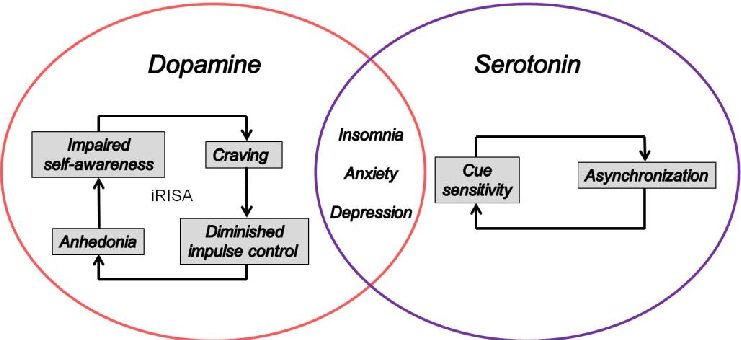
![Figure 1. The iRISA syndrome [76] in addiction is centrally controlled by dopamine in the brain, while asynchronization, presumed to be linked to cue sensitivity in digital addiction [50–54], is centrally controlled by serotonin. A deficit in both neurotra](https://pdfs.citedhealth.com/figures/35682491/101.png)
विवरण
The impaired Response Inhibition and Salience Attribution (iRISA) syndrome model is illustrated, showing how dopamine-mediated reward pathways in the brain drive cue sensitivity in digital addiction and contribute to sleep disruption.
Figure 6
Diagram
741 × 340px
· 126.5 केबी
Source Paper
Digital Addiction and Sleep.International journal of environmental research and public health (2022)
PMID: 35682491
Cite This Figure
 > Source: Birgitta Dresp-Langley et al. "Digital Addiction and Sleep.." *International journal of environmental research and public health*, 2022. PMID: [35682491](https://pubmed.ncbi.nlm.nih.gov/35682491/)
<figure>
  <img src="https://pdfs.citedhealth.com/figures/35682491/101.png" alt="The impaired Response Inhibition and Salience Attribution (iRISA) syndrome model is illustrated, showing how dopamine-mediated reward pathways in the brain drive cue sensitivity in digital addiction and contribute to sleep disruption." />
  <figcaption>Figure 6. The impaired Response Inhibition and Salience Attribution (iRISA) syndrome model is illustrated, showing how dopamine-mediated reward pathways in the brain drive cue sensitivity in digital addiction and contribute to sleep disruption.<br>  Source: Birgitta Dresp-Langley et al. "Digital Addiction and Sleep.." <em>International journal of environmental research and public health</em>, 2022. PMID: <a href="https://pubmed.ncbi.nlm.nih.gov/35682491/">35682491</a></figcaption>
</figure>