Description
Circadian phase-response curve for exogenous melatonin, demonstrating how timing of administration determines whether it advances or delays the circadian clock.
More Figures from This Paper
Figure 3
Forest plot showing melatonin's effect on total sleep time across included studies. The overall effect suggests a small increase in sleep duration, with considerable heterogeneity between studies.
forest_plot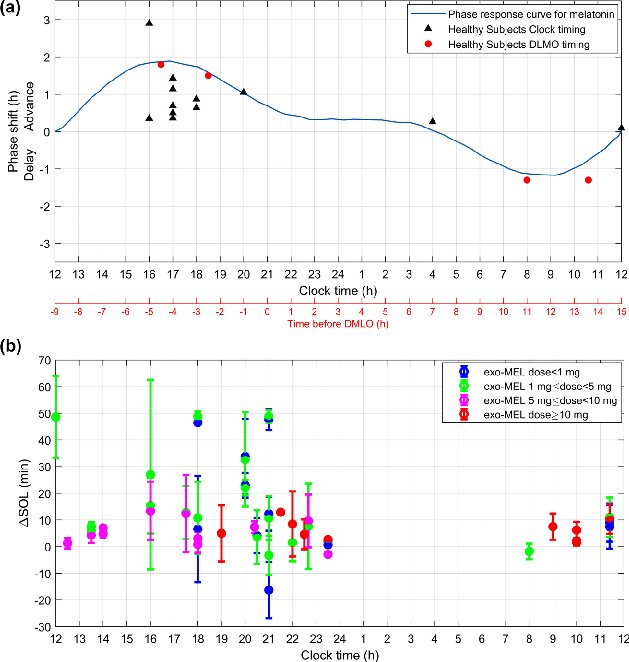
Figure 4
Dose-response analysis of melatonin supplementation on sleep parameters, indicating that lower physiological doses may be as effective as higher pharmacological doses for circadian rhythm regulation.
chartFigure 5
Chart
753 × 724px
· 262.9 KB
Source Paper
Melatonin as a Chronobiotic with Sleep-promoting Properties.Cite This Figure
 > Source: Francy Cruz-Sanabria et al. "Melatonin as a Chronobiotic with Sleep-promoting Properties.." *Current neuropharmacology*, 2023. PMID: [35176989](https://pubmed.ncbi.nlm.nih.gov/35176989/)
<figure>
  <img src="https://pdfs.citedhealth.com/figures/35176989/2269.png" alt="Circadian phase-response curve for exogenous melatonin, demonstrating how timing of administration determines whether it advances or delays the circadian clock." />
  <figcaption>Figure 5. Circadian phase-response curve for exogenous melatonin, demonstrating how timing of administration determines whether it advances or delays the circadian clock.<br>  Source: Francy Cruz-Sanabria et al. "Melatonin as a Chronobiotic with Sleep-promoting Properties.." <em>Current neuropharmacology</em>, 2023. PMID: <a href="https://pubmed.ncbi.nlm.nih.gov/35176989/">35176989</a></figcaption>
</figure>