Bioprospecting and Molecular Identification of Used Transformer Oil-Degrading Bacteria for Bioplastics Production.
Study Design
- Studientyp
- Other
- Population
- None
- Intervention
- Bioprospecting and Molecular Identification of Used Transformer Oil-Degrading Bacteria for Bioplastics Production. None
- Vergleichsgruppe
- None
- Primärer Endpunkt
- None
- Wirkungsrichtung
- Mixed
- Verzerrungsrisiko
- Unclear
Abstract
One of the major impediments to the commercialization of biodegradable plastic is the high cost of substrate. Consequently, there is a continuous search for effective microorganisms and cheaper carbon substrates to reduce the high production cost. In this study, waste transformer oil-degrading bacteria were isolated from soil, wastewater, and sediment samples, using a mineral salt medium (MSM) supplemented with 1% waste transformer oil as the sole carbon source. The isolates were screened for polyhydroxyalkanoates (PHA) production using Nile red staining and fluorescence microscopy. PHA granules accumulation was confirmed using transmission electron microscopy. Oil degradation analysis was accomplished using solvent extraction and gravimetric methods whereas, the bacteria were identified using 16S DNA sequence homology. A total of 62 transformer oil-degrading bacteria were isolated, out of which 16 (26%) showed positive results for Nile red fluorescence microscopy. The identified organisms belong to four different taxonomic genera of Acinetobacter, Bacillus, Proteus, and Serratia. The percentage of oil degradation observed among the different isolates ranged between 19.58% and 57.51%. Analysis of the PHA extracted from the selected isolate revealed the presence of medium chain length polyhydroxyalkanoates (mcl-PHA). The findings of this work have further highlighted the diversity of the bacteria capable of utilizing waste streams such as waste transformer oil. Consequently, the isolates can be explored as agents of converting waste transformer oil into bioplastics.
Zusammenfassung
Waste transformer oil-degrading bacteria isolated from soil, wastewater, and sediment samples, using a mineral salt medium supplemented with 1% waste transformer oil as the sole carbon source, highlight the diversity of the bacteria capable of utilizing waste streams such as Waste transformer oil.
Full Text
microorganisms
Article
Bioprospecting and Molecular Identification of Used Transformer Oil-Degrading Bacteria for Bioplastics Production
Shehu Idris 1,2 , Rashidah Abdul Rahim 1 and Al-Ashraf Abdullah Amirul 1,3,*
- 1 School of Biological Sciences, Universiti Sains Malaysia, Gelugor 11800, Penang, Malaysia; [email protected] (S.I.); [email protected] (R.A.R.)
- 2 Department of Microbiology, Kaduna State University, Kaduna PMB 2339, Nigeria
- 3 Centre for Chemical Biology, Universiti Sains Malaysia, Bayan Lepas 11900, Penang, Malaysia
* Correspondence: [email protected]; Tel.: +601-3439-3662
Citation: Idris, S.; Abdul Rahim,R.; Abdullah Amirul, A.-A. Bioprospecting and Molecular Identification of Used Transformer Oil-Degrading Bacteria for Bioplastics Production. Microorganisms 2022, 10, 583. https://doi.org/10.3390/ microorganisms10030583
Academic Editor: Mohammad Taherzadeh
Received: 1 December 2021 Accepted: 1 March 2022 Published: 8 March 2022
Copyright: © 2022 by the authors. Licensee MDPI, Basel, Switzerland. This article is an open access article distributed under the terms and conditions of the Creative Commons Attribution (CC BY) license (https:// creativecommons.org/licenses/by/ 4.0/).
Abstract: One of the major impediments to the commercialization of biodegradable plastic is the high cost of substrate. Consequently, there is a continuous search for effective microorganisms and cheaper carbon substrates to reduce the high production cost. In this study, waste transformer oil-degrading bacteria were isolated from soil, wastewater, and sediment samples, using a mineral salt medium (MSM) supplemented with 1% waste transformer oil as the sole carbon source. The isolates were screened for polyhydroxyalkanoates (PHA) production using Nile red staining and fluorescence microscopy. PHA granules accumulation was confirmed using transmission electron microscopy. Oil degradation analysis was accomplished using solvent extraction and gravimetric methods whereas, the bacteria were identified using 16S DNA sequence homology. A total of 62 transformer oil-degrading bacteria were isolated, out of which 16 (26%) showed positive results for Nile red fluorescence microscopy. The identified organisms belong to four different taxonomic genera of Acinetobacter, Bacillus, Proteus, and Serratia. The percentage of oil degradation observed among the different isolates ranged between 19.58% and 57.51%. Analysis of the PHA extracted from the selected isolate revealed the presence of medium chain length polyhydroxyalkanoates (mcl-PHA). The findings of this work have further highlighted the diversity of the bacteria capable of utilizing waste streams such as waste transformer oil. Consequently, the isolates can be explored as agents of converting waste transformer oil into bioplastics.
Keywords: bioprospecting; waste transformer oil; bioplastic; polyhydroxyalkanoates
1. Introduction
Synthetic plastics have become an important commodity considered to have improved the quality of human life, replacing packaging materials like glasses and paper [1]. Rapid development in material science and technology has undoubtedly brought about new plastic products with excellent mechanical integrity as well as durability [2]. However, the production of synthetic plastics has a great disadvantage of creating non-degradable waste products that are difficult to handle. The non-biodegradable property of these products, particularly high molecular mass and complex structure, impart a serious environmental problem as they can persist in the soil, water bodies, and landfills. Consequently, the accumulation of plastic waste in the environment has become a source of major concern and a worldwide issue [1]. The current situation of waste plastics management in developed nations, though slowly improving, is far from satisfactory. As for the developing countries, such waste management can be described as less promising [3]. Several researchers across the globe have been trying to provide a solution to this ever-increasing environmental challenge.
Over a long period, petroleum-based mineral oils have been used in electrical transformers, primarily for insulating purposes; the oil also serves as a coolant for the transformers. However, the long-term usage of transformer oil results in some changes in its physical
Microorganisms 2022, 10, 583. https://doi.org/10.3390/microorganisms10030583 https://www.mdpi.com/journal/microorganisms
and chemical characteristics, which consequently makes it unfit for cooling and insulating purpose [4]. Lack of proper storage and disposal of the used oils, as well as explosions of transformers, can cause a serious environmental pollution problem. Thus, the disposal of used transformer oil (UTO) from electrical power stations, as well as a large number of electrical transformers located in populated areas and shopping centers throughout the world, is becoming increasingly complex. This is because it could contaminate waterways and soil if serious spills happen. This problem necessitates the need to look for better management approaches to provide an immediate solution [4]. Coincidentally, there is a concerted effort in the search for cheaper substrates to produce biodegradable plastics to reduce the existing high production cost that remain a big challenge to the commercialization of this eco-friendly alternative product. From a technological viewpoint, polyhydroxyalkanoates (PHAs) draw much attention due to their biodegradability, thermoplasticity, and biocompatibility, as well as their production, which starts from abundantly available renewable resources [5]. PHAs seem to be potential candidates that could replace some conventional plastics [6].
According to recent reports, there have been several attempts to produce bioplastic using oils and waste oils, such as waste glycerol [7,8], palm oil [9], crude glycerol [10,11], and plant oils [12]. Reports on plastic consumption per capita indicate high demand. Therefore, it is evident that consumption of plastic products will be very difficult to reduce, probably due to the versatile properties of synthetic plastics and the corresponding low market price. However, there is a possibility of replacing petroleum-based plastics with alternative materials with similar properties that degrade after being discarded [2]. PHAs are a family of polyesters having side chains that differ in length from a simple methyl moiety (Polyhydroxybutyrate) to alkyl chains up to more than 15 carbons long. They are broadly classified into two divisions: namely, short-side chain length (scl) with up to two carbons in the side chain and medium-chain length (mcl) having three or more carbons in the side chain [13]. Those having 16 and above carbons in their monomers are considered long-chain length (lcl). Bacteria and other microbes can produce PHAs as intracellular carbon and energy reserves under stress conditions [14]. Although these bioplastics are biodegradable and bio-compatible, they are presently not priced competitive largely since the sugars (glucose) commonly used as fermentation feedstocks are expensive. Therefore, the importance of finding a less expensive substrate cannot be overemphasized [15].
Earlier applications were mostly in the areas of packaging (e.g., shampoo bottles, other cosmetic containers [16,17], covers for cardboards and papers, milk cartons and films, moisture barriers in nappies and sanitary towels, pens, combs, bullets, and bulk chemical production [18]. Microorganisms, particularly bacteria, can produce bioplastic from numerous carbon sources that include but are not limited to inexpensive, complex waste effluents, fatty acids, plant oils, alkanes, and simple carbohydrates [19]. UTO has been valorized for many purposes, especially biofuel [20] and alternative fuel [4,21]. Although the waste transformer oil has been the subject of many studies in terms of microbial degradation, to the best of our knowledge, waste oil has not been studied as a substrate for the production of PHAs. In this report, we described the isolation and screening of PHAproducing strains of the waste transformer oil-degrading bacteria to target the utilization of such organisms in the bioconversion of UTO into biodegradable plastics.
2. Materials and Methods
- 2.1. Collection of Samples
A total of 12 samples represented by soil, wastewater, and sediment were collected aseptically from various locations in Penang, Malaysia. The sampling sites include Pulau Burung, Sungai Chenaam, Sungai Pinang, Sungai Jelutong, Penang Bridge, and Batu Ferringi Beach. The samples collected were then transferred immediately to the laboratory at the School of Biological Sciences, Universiti Sains Malaysia, for analysis. All the samples were kept at 4 ◦C until required for use. The sample of used transformer oil was obtained from Tenaga National Berhad Research (TNBR) Malaysia.
2.2. Bacterial Isolation
The used transformer oil-degrading bacteria were isolated from the environmental samples via enrichment culture techniques. The isolation was accomplished using a mineral salt medium (MSM) supplemented with 1% v/v waste transformer oil as the sole carbon source. The basic medium (MSM) contains gram per liter of K2HPO4 (5.8); KH2PO4 (3.7); (NH4)2SO4 (1.1); MgSO4 7H2O (0.2). Other components include 1.0 mL of micro-element solution containing gram per liter FeSO4·7H2O (2.78); CaCl2·2H2O (1.67); MnCl2·4H2O (1.98); CoSO4·7H2O (2.81); CuCl2·2H2O (0.17); ZnSO4·2H2O (0.29); in 0.1 M HCl [22]. The used oil added to the medium was initially emulsified with one volume of Tween 80. One gram (1 g) of the solid samples (soil/sediment) or 1 mL, in the case of liquid samples (wastewater), was aseptically added to 100 mL MSM in a 250 mL Erlenmeyer flask. The culture was then incubated at 30 ◦C, 200 rpm for 72 h. Serial dilution of the enrichment culture was performed, followed by spread plate inoculation of the aliquot on the mineral salt agar containing 1% v/v used transformer oil. The inoculated culture plates were then incubated at 30 ◦C for 72 h. The morphologically distinct colonies were sub-cultured on the nutrient agar to obtain pure cultures of the isolates. Stock cultures were preserved in 20% glycerol and kept at −20 ◦C for the subsequent analysis.
2.3. Screening for PHA Production
The preserved isolates from the glycerol stock were transferred in 30 mL nutrient-rich broth (10 g/L peptone, 2 g/L yeast extract, and 10 g/L Lab Lemco) and grown at 30 ◦C, 150 rpm for 12–24 h. Subsequently, an aliquot (1 mL) taken from the culture was serially diluted in sterile distilled water. After that, 0.1 mL was taken from a selected dilution tube and inoculated on solid mineral salts medium containing 5 µg/mL Nile red [23]. The culture plates were then incubated at 30 ◦C for 24–48 h. Colonies that formed were sub-cultured in replicate onto a fresh medium. All the original plates were then exposed to ultraviolet illumination (320 nm) to identify PHA producers that exhibited pink fluorescence [22]. Fluorescence microscopic technique was also used to further identify the PHAs producing isolates. Briefly, 1 mL of the 72 h culture grown in MSM supplemented with 1% used transformer oil was transferred into the Eppendorf tube. About 50 µL of Nile red (5 µg/mL) and 500 µL distilled water were added to the cell suspension and Vortex mixer immediately. The suspension was kept at room temperature for 1–2 h and then centrifuged at 1000× g for 5 min. The supernatant was then discarded, and the pellet was washed twice with distilled water. About 500 µL of distilled water was then added to the pellet and vortex mix. After that, 10 µL of the stained cell suspension was placed onto a clean glass slide and covered with a glass slip. The edge of the glass slip covering the stained cells was then sealed with Cutex. Finally, the prepared samples were observed using a compound fluorescence light microscope (Olympus BX53, Olympus Optical Co. Ltd., Tokyo, Japan) equipped with an Olympus DP72 camera. The observation was completed under X100 UV compatible objective to confirm the presence of PHA granules [24]. Other microscopic analyses (SEM and phase-contrast microscopy) were executed as described elsewhere [9,25].
2.4. Analysis of Used Transformer Oil Degradation
The analysis of the used transformer oil degradation by the bacteria was performed using the gravimetric method after fermentation in 50 mL of MSM containing 2% v/v UTO, incubated at 30 ◦C for 72 h. In this technique, the residual oil in the culture supernatant was extracted for weight measurement to quantify the amount of the oil consumed during incubation. A solvent extraction method using n-hexane was adopted [26]. The weight of the used oil added into the medium (W1) was initially measured. After incubation, the culture supernatant containing the residual oil was recovered by centrifugation at 10,000× g for
5 min. About 5 mL of the solvent (n-hexane) was added to the supernatant in a clean 50 mLfalcon tube and Vortex mixer. It was then transferred into a thistle funnel and kept for atleast 4 h to allow for phase separation. The top layer (organic phase) containing a mixture ofn-hexane and the residual oil was then separated from the aqueous layer. The aqueous phase
was again mixed with an additional 5 mL n-hexane to extract the residual oil further. The total organic phase was subsequently collected into a pre-weighed Petri dish and kept overnight at room temperature for complete evaporation of n-hexane. The test was performed in triplicate, from which the mean was computed to minimize error. The gravimetric estimation of the percentage of the oil degradation was performed according to Equation (1) below:
Degradation (%) = “W2 − W3”/W1 × 100 (1) where:
- W1 = weight of the oil added to the medium.
- W2 = weight of the petri dish plus weight of residual oil after solvent evaporation.
- W3 = weight of the petri dish.
- 2.5. Shake Flask Fermentation and PHA Quantification
- 2.6. PHAs Monomers Analysis
- 2.7. Bacterial Identification
For bacterial identification, the genomic DNA of the isolated bacteria was extracted using a DNA extraction kit (GF-1 extraction kit), according to the manufacturer’s instructions. The target gene (16S rRNA) for the identification was amplified using a Polymerase chain reaction with 27F (5 -AGAGTTTGATCMTGGCTCAG-3 ) and 1492R (5 -TACGGYTACCTTGTTACGACTT-3 ) as forward and reverse primers, respectively. The amplification was performed in 50 µL reaction mixture comprising 25 µL master mix (dNTP, MgCl2, Taq polymerase, and buffer), 2 µL each of template DNA, forward and reverse primers, and 19 µL of Ultrapure water [29]. The sequencing of the amplicons was
conducted by MyTACG Bioscience Enterprises, Kuala Lumpur, Malaysia. The sequence data of each isolate were assembled and aligned using ClustalW and subsequently compared with existing sequences of the GenBank database using BLAST Available online: http://www.ncbi.nlm.nih.gov/blast (accessed on 13 November 2021) [30]. The identity of each isolate was inferred based on the percentage sequences similarity with the top hit of the BLAST search result (sequence with significant alignment). The sequences of all the identified organisms were subsequently deposited in the GenBank database, and the accession numbers were respectively assigned for reference.
- 3. Results 3.1. Bacterial Isolation and Screening for PHA Production
A total of 62 strains of used transformer oil-degrading bacteria were isolated on the mineral salt agar. These isolates demonstrated their capacity to degrade waste transformer oil by their ability to grow in the medium-containing waste transformer oil as the sole carbon source. Table 1 summarizes the abundance of these organisms in relation to the source from which they were obtained.
- Table 1. The abundance of used transformer oil-degrading bacteria in the various environmental samples collected in Penang.
- Table 2. Nile red PHA screening response of the used transformer oil-degrading bacteria.
Number of Isolates Screened
Sample Code Sample Type
Number of Positive Isolates
- PBA Wastewater 5 1
- PBB Wastewater 3 1 SCA Wastewater 6 2 SCC Sediment 3 1 SPA Wastewater 8 0 SPD Soil 5 3
- SJA Wastewater 8 0
- SJB Wastewater 5 4 BFA Water 2 0 BFC Sediment 6 2 PPB Water 3 1 PPD Soil 5 1 UTO Used Oil 3 0
62 16 (26%)
Microorganisms 2022, 10, 583 6 of 12
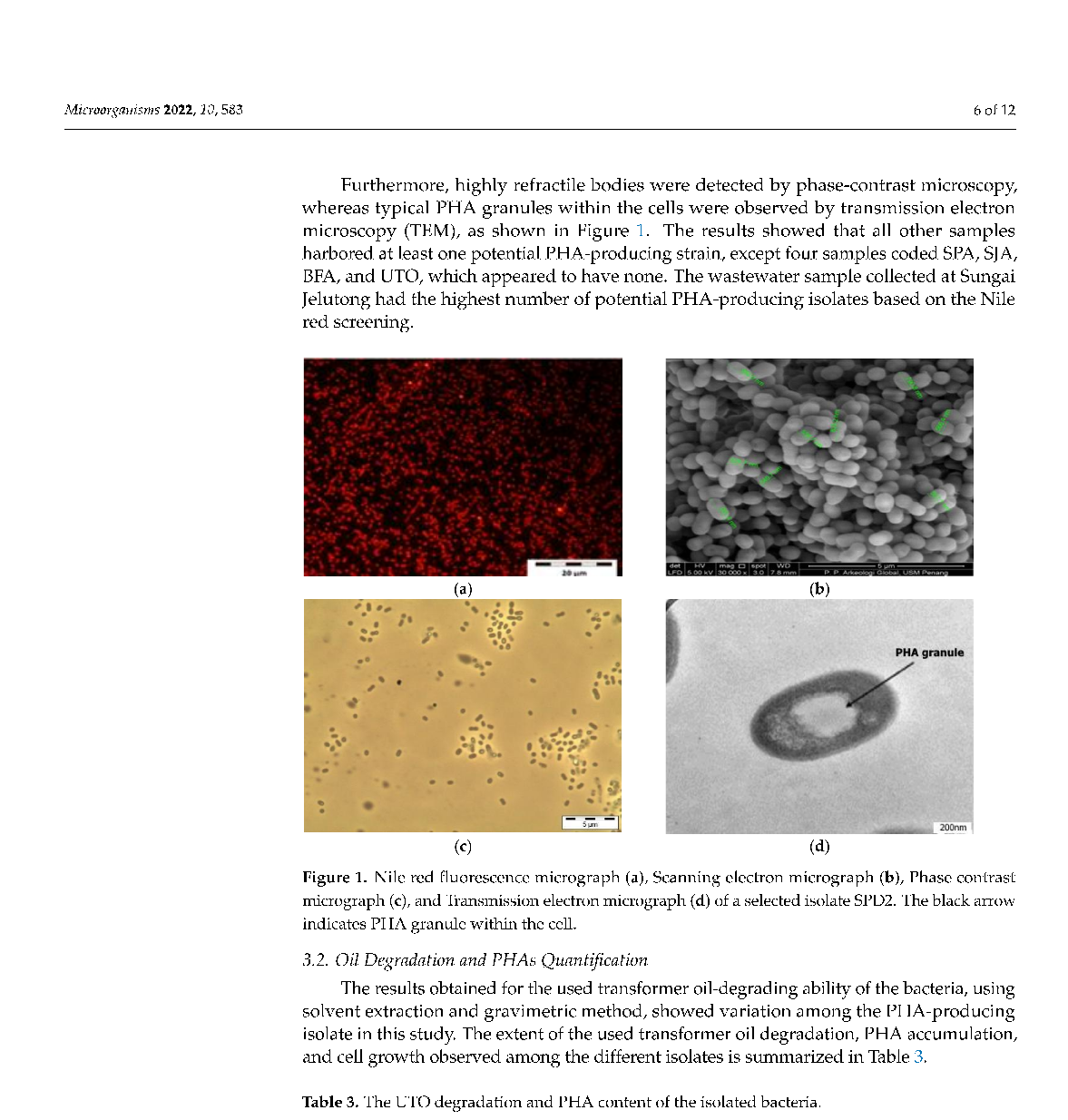
Furthermore, highly refractile bodies were detected by phase-contrast microscopy, whereas typical PHA granules within the cells were observed by transmission electron microscopy (TEM), as shown in Figure 1. The results showed that all other samples harbored at least one potential PHA-producing strain, except four samples coded SPA, SJA, BFA, and UTO, which appeared to have none. The wastewater sample collected at Sungai Jelutong had the highest number of potential PHA-producing isolates based on the Nile red screening.
- Figure 1. Nile red fluorescence micrograph (a), Scanning electron micrograph (b), Phase contrast micrograph (c), and Transmission electron micrograph (d) of a selected isolate SPD2. The black arrow indicates PHA granule within the cell.
- 3.2. Oil Degradation and PHAs Quantification
The results obtained for the used transformer oil-degrading ability of the bacteria, using solvent extraction and gravimetric method, showed variation among the PHA-producing isolate in this study. The extent of the used transformer oil degradation, PHA accumulation, and cell growth observed among the different isolates is summarized in Table 3.
Table 3. The UTO degradation and PHA content of the isolated bacteria.
BFC1 23.78 ± 0.46 33.06 ± 0.19 2.22 ± 0.29 BFC4 33.21 ± 1.96 17.62 ± 0.24 3.49 ± 0.98 PBA4 19.58 ± 1.73 13.75 ± 0.15 2.27 ± 0.24 PBB2 53.65 ± 0.29 8.15 ± 0.07 1.41 ± 1.10 PPD5 52.92 ± 2.35 16.39 ± 0.42 2.64 ± 0.13 SCA1 32.15 ± 0.29 21.33 ± 0.19 0.26 ± 2.25 SCA6 35.12 ± 0.29 6.95 ± 0.07 3.22 ± 0.71 SCC1 53.46 ± 0.29 19.77 ± 0.17 2.29 ± 0.22 SJA7 54.29 ± 0.29 14.42 ± 0.32 4.82 ± 2.31
- SJB1 48.08 ± 0.29 18.41 ± 0.62 0.31 ± 2.20
- SJB2 57.51 ± 2.06 12.31 ± 0.14 3.91 ± 1.40
- SJB3 30.05 ± 1.75 11.13 ± 0.13 1.70 ± 0.81 SB5 46.96 ± 1.62 20.88 ± 0.06 3.91 ± 1.40
SPD2 45.42 ± 1.09 31.12 ± 0.12 4.19 ± 1.68 SPD3 27.12 ± 1.14 21.51 ± 0.17 1.12 ± 1.39 SPD4 28.58 ± 1.20 12.32 ± 0.07 2.37 ± 0.14
Key: CDW = Cell dry weight. a: The data values are the average of the three experimental replicates.
The PHA biosynthesis was accomplished in shake flasks. The quantitative analysis of the polymer accumulation using the gas chromatographic method revealed that the PHA content ranged from 6.95 ± 0.07 to 33.06 ± 0.19% of CDW. Isolates BFC1 and SPD2 produced a higher percentage of PHA content (>30%) than the other isolates. The lowest PHA content (6.95 ± 0.07%) was recorded from isolate SCA6. The growth measured in terms of cell dry weight shows a range of 0.26 ± 2.25 to 4.82 ± 2.31 g/L, with isolate PBA4 and SJA7 having the lowest and highest, respectively.
- 3.3. PHA Monomer Identification
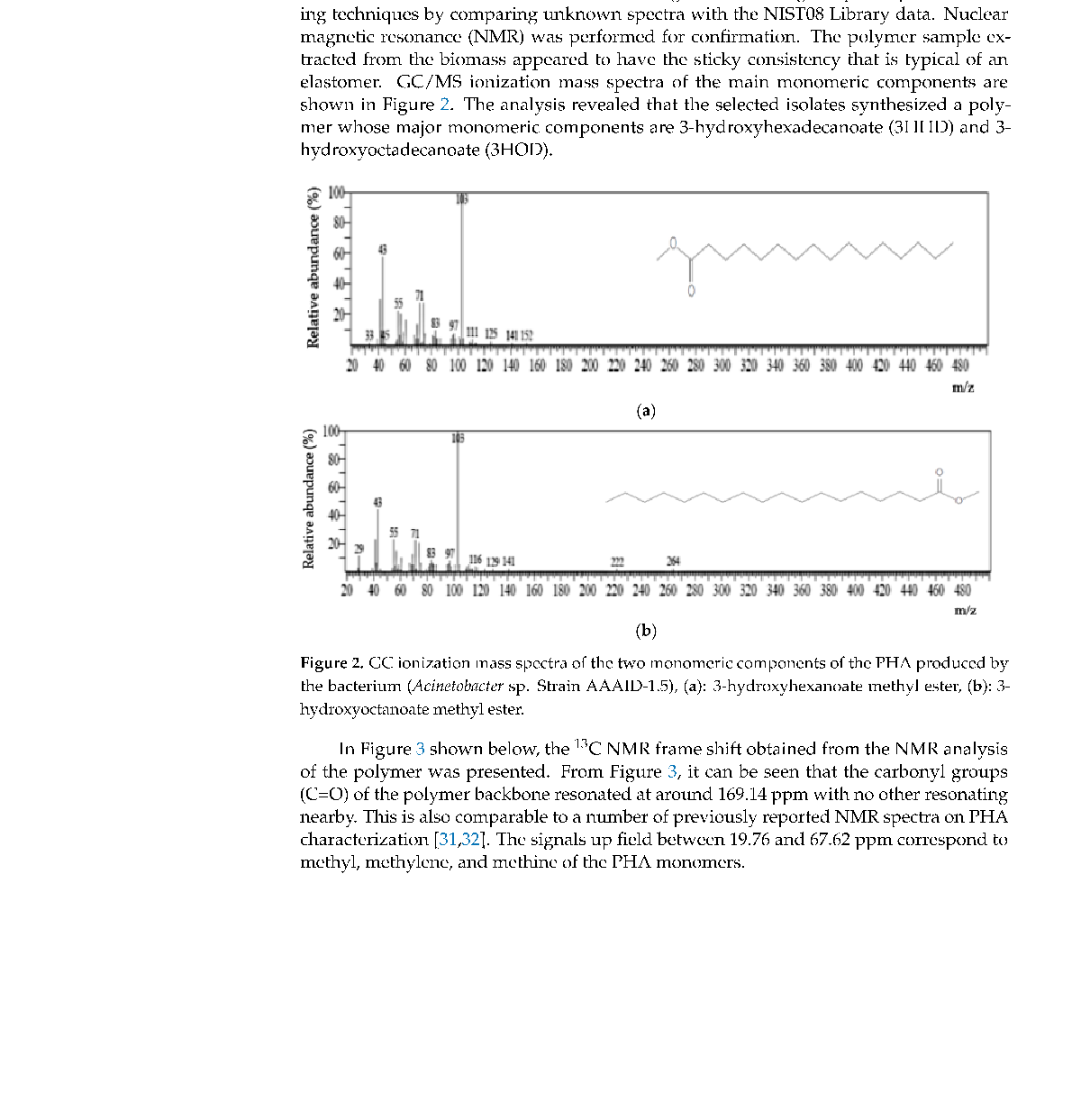
The PHA monomers were identified through GC/MS using computer spectral matching techniques by comparing unknown spectra with the NIST08 Library data. Nuclear magnetic resonance (NMR) was performed for confirmation. The polymer sample extracted from the biomass appeared to have the sticky consistency that is typical of an elastomer. GC/MS ionization mass spectra of the main monomeric components are shown in Figure 2. The analysis revealed that the selected isolates synthesized a polymer whose major monomeric components are 3-hydroxyhexadecanoate (3HHD) and 3hydroxyoctadecanoate (3HOD).
- Figure 2. GC ionization mass spectra of the two monomeric components of the PHA produced by the bacterium (Acinetobacter sp. Strain AAAID-1.5), (a): 3-hydroxyhexanoate methyl ester, (b): 3hydroxyoctanoate methyl ester.
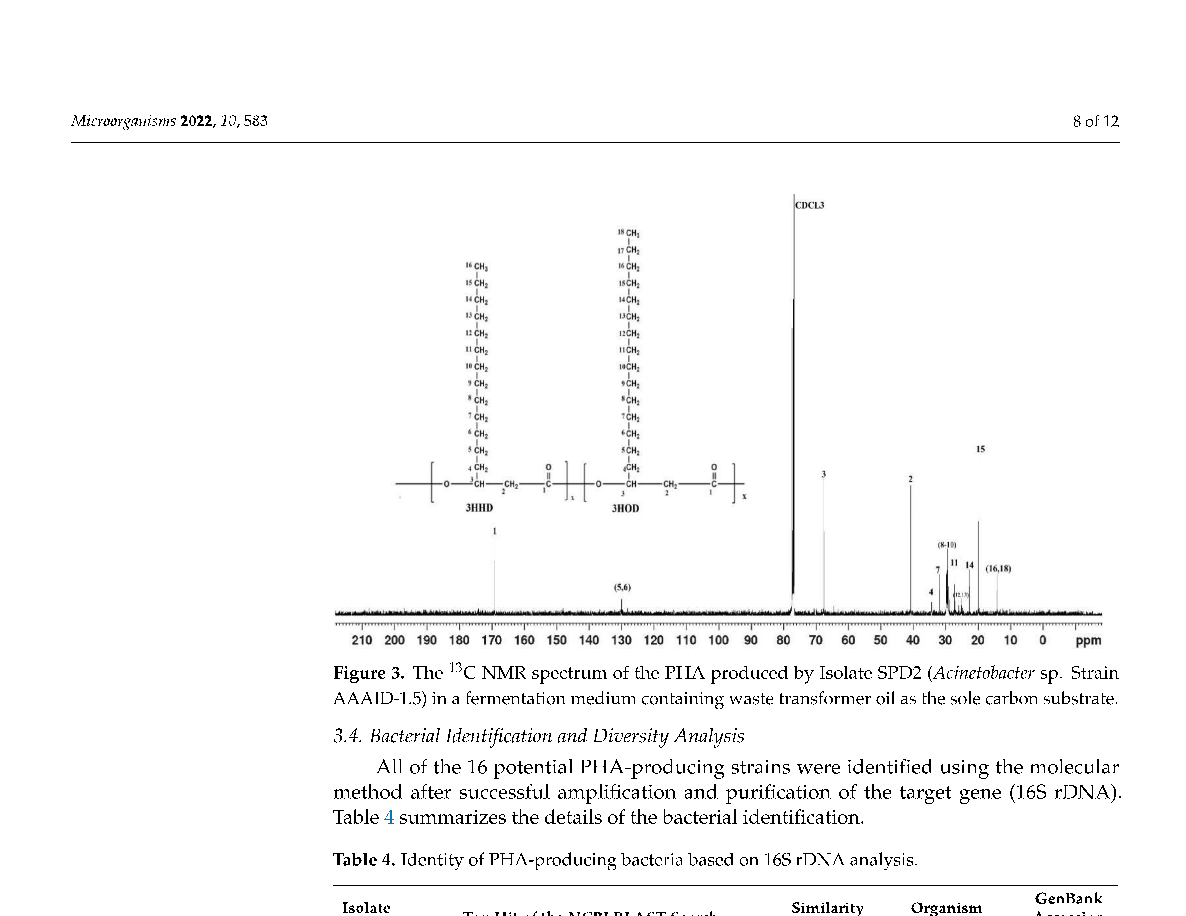
In Figure 3 shown below, the 13C NMR frame shift obtained from the NMR analysis of the polymer was presented. From Figure 3, it can be seen that the carbonyl groups (C=O) of the polymer backbone resonated at around 169.14 ppm with no other resonating nearby. This is also comparable to a number of previously reported NMR spectra on PHA characterization [31,32]. The signals up field between 19.76 and 67.62 ppm correspond to methyl, methylene, and methine of the PHA monomers.
Microorganisms 2022, 10, 583 8 of 12
Figure 3. The 13C NMR spectrum of the PHA produced by Isolate SPD2 (Acinetobacter sp. Strain AAAID-1.5) in a fermentation medium containing waste transformer oil as the sole carbon substrate.
3.4. Bacterial Identification and Diversity Analysis
All of the 16 potential PHA-producing strains were identified using the molecular method after successful amplification and purification of the target gene (16S rDNA). Table 4 summarizes the details of the bacterial identification.
Table 4. Identity of PHA-producing bacteria based on 16S rDNA analysis.
GenBank Accession Number
Isolate Code
Similarity (%)
Organism Identified
Top Hit of the NCBI BLAST Search
BFC1 Acinetobacter sp. Strain Gamma-15 99.45 Acinetobacter sp. MZ411707 BFC4 Acinetobacter sp. Strain WWW203 99.01 Acinetobacter sp. MZ411708 PBA4 Bacterium Stain Glm4 99.79 Acinetobacter sp. MZ411699 PBB2 Serratia marcescens Strain KS10 99.79 Serratia marcescens MZ411696 PPD5 Acinetobacter sp. HS-B1 99.51 Acinetobacter sp. MZ411697 SCA1 Bacterium Stain CH-12 99.38 Acinetobacter sp. MZ411704 SCA6 Proteus Vulgaris 81.74 Proteus sp. MZ411698 SCC1 Acinetobacter sp. Strain PrPc065 99.86 Acinetobacter sp. MZ411695 SJA7 Uncultured Bacterium Clone SH201207-62 99.65 Acinetobacter sp. MZ411705
- SJB1 Serratia marcescens Strain RS 99.93 Serratia marcescens MZ411693
- SJB2 Bacterium Stain N13.7 98.03 Acinetobacter sp. MZ411694
- SJB3 Serratia marcescens Strain KS10 99.51 Serratia marcescens MZ411702 SJB5 Acinetobacter bereziniae Strain XH901 99.72 Acinetobacter sp. MZ411703
- 4. Discussion
The isolation of bacteria from the various samples revealed the presence of diverse bacterial strains capable of utilizing used transformer oil as a sole carbon source. The abundance and diversity of the isolated organisms in this research could be linked to the availability of essential nutrients that support microbial life in those environments. The samples collected at Sungai Jelutong and Sungai Pinang had more morphotypes than the other sample sources, with each having eight morphologically distinct colonies. The isolation of these organisms from the various environmental sources was not unexpected. Many
microbes that accumulate PHAs as storage materials can be found in natural environments such as soil, seawater, sewage sludge, or compost [33]. There have also been many reports in which diverse species of microbes were isolated from oil-contaminated sites. Specifically, transformer oil-degrading bacteria were previously isolated from oil-contaminated soil. For instance, Acinetobacter and Bacillus species, in addition to Pseudomonas and Micrococcus, were isolated from soil samples using mineral salt medium containing used transformer oil as the sole carbon source [34]. Furthermore, the transformer oil is rich in hydrocarbons [35] and those diverse groups of microorganisms, particularly bacteria, were found to have the capacity to degrade these compounds [36].
With respect to the PHAs screening, the results shown in Table 2 revealed that 16 isolates out of the 62 were positive to Nile red fluorescence microscopy. These findings signify that about 26% of all the isolated bacteria are potential PHA producers capable of utilizing the used transformer oil as a carbon source. Several researchers have employed this screening method for the preliminary screening of PHA-producing bacteria to discriminate between PHA-producing strains from the non-producing ones [23,37–41]. Despite its drawback, the method remains a powerful means of discriminating the PHA-positive from the PHA-negative strains, especially when complemented with certain advanced microscopic techniques, such as the use of a transmission electron microscopy that could identify the PHA producers with reasonable certainty. The results of the screening demonstrated the presence of promising, wild-type PHA producers. Interestingly, these findings are comparable to many reports in the literature that reported the identification of potent PHA producers using a similar approach [8,42–44].
The extent of the used oil degradation among the bacteria, as shown in Table 3, ranged from 19.58 to 57.51%. The isolates SJB2 were found to degrade the waste oil better than the other isolates; the lowest percentage degradation (19.58 ± 1.73%) was recorded from isolate PBA4. Microorganisms can only degrade oil substrate if they are able to synthesize hydrolytic enzymes, specifically lipases [45]. The efficiency with which an organism expresses the gene coding for these hydrolytic enzymes, and the ability to release the enzymes to their surroundings, could impact the organisms’ oil-degrading capacity. Used transformer oil is a complex mixture of hydrocarbon. Some microorganisms in nature have been found to have the capacity of degrading complex hydrocarbon, either as consortia or single species culture [46]. Biodegradation of waste oils can be considered a natural process limited by several physical and chemical factors [47]. The ability of the isolated bacteria to utilize the used transformer oil, as observed in this work, could be attributed to the possession of hydrolytic enzymes, such as lipases that help in cleavage the complex carbon structures of the oil. The PHA accumulation was quantified using GC analysis; previously, the monomeric components of the PHA were identified through GC/MS, in which the spectra obtained revealed the presence of 3-hydroxyhexadecanoate (3HHD) and 3-hydroxyoctadecanoate (3HOD) as the major polymer constituent. The PHA contents of the isolated bacteria were relatively low, except for isolate BFC1 and SPD2 that produced greater than 30%. This indicates that some organisms are more efficient in bioconversion of the carbon source into the target product (PHA), probably due to their superior metabolic versatility. Furthermore, considering the complexity of various carbon structures associated with the used transformer oil, the organisms have demonstrated a reasonable potential in bioconversion of this used oil. PHA biosynthesis using waste streams as carbon substrates is desirable because such wastes are inexpensive materials that can be obtained with little or no cost. Additionally, utilizing waste as a substrate helps reduce the treatment and management costs. The accumulation of PHA with monomers having up to 16 and 18 carbon atoms represents one of the interesting findings of this research. PHAs with such monomers are rarely encountered. However, there are few studies that documented the detection of such monomers in microbially-synthesized PHAs. Example of such studies is the one in which 3-hydroxyhexadecanoate (3HHD) was found as a constituent of the PHA produced by Pseudomonas aeruginosa 42A2 using glucose as a carbon source [34]. Thus, the results of the present work have further substantiated the previous report on
the biosynthesis of these unique PHAs. The utilization of used transformer oil as a sole carbon source by the isolated organisms indicated the prospect of WTO utilization in PHA biosynthesis. Free fatty acids (FFAs) are released when oils are hydrolyzed, The FFAs could undergo β-oxidation to form a precursor for PHA biosynthesis [48]. Many bacterial species were reported to have the capacity of synthesizing PHA from unrelated carbon feedstock [44]. In another study, Pseudomonas putida KT2440 produced medium-chain length PHAs during nutrient limitation when grown on unrelated carbon sources [45]. The application of different waste materials for biosynthesis of PHA is considered a good strategy partly because it is cost-efficient and helps address disposal problems [49,50].
From the results of bacterial identification, it can be observed that Acinetobacter species were the most frequently isolated organisms (Table 4). The identity of these isolates was inferred based on their 16S rDNA sequences similarity with the existing sequences of the GenBank of the National Centre for Biotechnology Institute (NCBI). The findings showed that most isolates shared >99% similarities to various bacterial species recovered from similar environmental sites. However, an exception was observed in isolates SCA6, SJB2, SPD4, and SPA6, with a percentage similarity of 81.74, 98.03, 95.78, and 93.00, respectively (Table 4). The soil and wastewater are reservoirs of diverse organisms. These habitats represent an environment where microbes are specifically stimulated to rapidly evolve different metabolic capabilities while competing among themselves and many different species, partly because many essential growth factors often could not be continuously found. Interestingly, the organisms isolated and identified from these environments have demonstrated the ability to actively degrade used transformer oil in the shake flask fermentation resulting in the accumulation of the polyhydroxyalkanoates.
5. Conclusions
In conclusion, this research has established the presence of a diverse group of bacteria capable of utilizing used transformer oil as a carbon source to produce polyhydroxyalkanoates, thereby providing the basis for exploring the potentials of used transformer oil as a cheaper alternative carbon feedstock to produce bioplastic.
Author Contributions: Conceptualization, A.-A.A.A.; methodology, formal analysis, S.I; resources, A.-A.A.A.; writing—original draft preparation, S.I.; writing—review and editing, S.I. and A.-A.A.A.; supervision, R.A.R.; project administration, A.-A.A.A.; funding acquisition, A.-A.A.A. All authors have read and agreed to the published version of the manuscript.
Funding: This research was funded by Universiti Sains Malaysia, grant number 1001/PBIOLOGI/ 8011067.
Institutional Review Board Statement: Not applicable. Informed Consent Statement: Not applicable. Data Availability Statement: Not applicable.
Acknowledgments: The authors would like to thank the management of Universiti Sains Malaysia (U.S.M.) and the Ministry of Higher Education Malaysia (MOHE) for providing the enabling environment for the conduct of this study.
Conflicts of Interest: The authors declare no conflict of interest.
Figures
Used In Evidence Reviews
Similar Papers
Clinical infectious diseases : an official publication of the Infectious Diseases Society of America · 2005
Prevalence of and associated risk factors for fluoroquinolone-resistant Neisseria gonorrhoeae in California, 2000-2003.
Journal of bone and mineral metabolism · 2013
Assessment of safety and efficacy of methylsulfonylmethane on bone and knee joints in osteoarthritis animal model.
International journal of molecular sciences · 2020
Safety and Molecular-Toxicological Implications of Cannabidiol-Rich Cannabis Extract and Methylsulfonylmethane Co-Administration.
Animal bioscience · 2022
Effects of dietary methyl sulfonyl methane and selenium on laying performance, egg quality, gut health indicators, and antioxidant capacity of laying hens.
Alcoholism, clinical and experimental research · 2022
Correlates of high phosphatidylethanol (PEth) levels and their concordance with self-reported heavy alcohol consumption among men who have sex with men who binge drink alcohol.
Journal of behavioral medicine · 2022