Figure 6
672 × 414px
· 62.8 KB
Source Paper
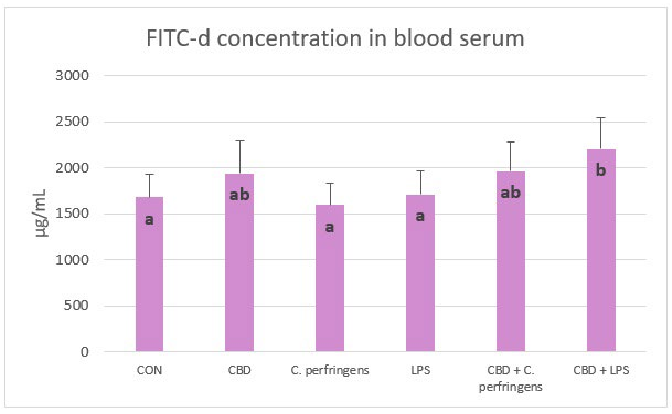
Interaction Between Peroxisome Proliferator-Activated Receptors and Cannabidiol in the Gut of Chickens Applied to Different Challenge Conditions.Cite This Figure
 > Source: Dominika Szkopek et al. "Interaction Between Peroxisome Proliferator-Activated Receptors and Cannabidiol ." *International journal of molecular sciences*, 2024. PMID: [39518951](https://pubmed.ncbi.nlm.nih.gov/39518951/)
<figure>
  <img src="https://pdfs.citedhealth.com/figures/39518951/204.png" alt="Figure 6. Serum fluorescein isothiocyanate-dextran (FITC-d) concentrations (µg/mL) in chickens fed control diets or CBD supplemented diet and as a result of E. coli LPS and C. perfringens challenge or no challenge. Significant differences are indicated by" />
  <figcaption>Figure 6. Figure 6. Serum fluorescein isothiocyanate-dextran (FITC-d) concentrations (µg/mL) in chickens fed control diets or CBD supplemented diet and as a result of E. coli LPS and C. perfringens challenge or no challenge. Significant differences are indicated by<br>  Source: Dominika Szkopek et al. "Interaction Between Peroxisome Proliferator-Activated Receptors and Cannabidiol ." <em>International journal of molecular sciences</em>, 2024. PMID: <a href="https://pubmed.ncbi.nlm.nih.gov/39518951/">39518951</a></figcaption>
</figure>